











Stay Informed
Sign up here for the latest articles



By Morag Cuddeford-Jones
Despite suggestions of nervousness in the market, we discover evidence of optimism and growth when it comes to implementing AI solutions across the brand spectrum.
Exceeding Expectations
When it comes to discussing AI, Diageo say that there’s no beginning and end with this race and that if it’s proven anything, it’s that once you do get going, the possibilities are endless. Experiment, expand – then exceed expectations.
If you limit your exploration of AI to the headlines, you’d be forgiven for thinking it’s overhyped, or at most a side-line experiment. But, scratch the surface and you will discover all manner of possibilities unlocked by the technology.
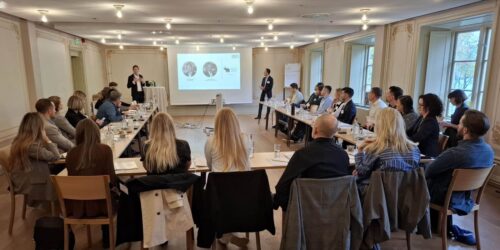
This was the takeaway from a gathering of the great and the good from brands, agencies and research institutions at OLIVER’s Breakthrough Breakfast celebrating AI’s move to the mainstream.
Entitled “Elevate from AI Experimentation to Excellence”, the event strove to demonstrate how organisations can break free of the tricky pilot phase into embedded AI strategy that is defined, measurable and successful.
The first thing to note is that the commitment is real. Nearly three quarters of CMOs (71%) plan to invest at least $10m annually in Generative AI over the next three years. Conducting the research that revealed this insight was Boston Consulting Group (BCG).
Joanna Stringer, BCG’s CMO noted that one of the reasons AI is finally gaining traction is attitudes to what AI means to your business. “The biggest challenge in moving scaling is not thinking about this as a tool you have bought but really understanding how it is going to change workflows.”
The complexity of many organisations can certainly be a hinderance in getting this clarity, which is why the B2B arena is proving more fertile ground for scaling AI. “It’s typically less sexy for marketing but it’s an area where the function is a bit simpler.
They tend to be less embedded in the organisation. B2B will be the dark horse that wins the race in driving sophistication,” Stringer teases.
Complexity certainly seems to be the enemy of AI adoption, particularly when moving it across the whole organisation rather than just operating in siloes. Measurement, for example – the holy grail for CEOs and CFOs as a way of keeping a lid on runaway AI investment – is a slippery customer.
“Measurement is really difficult. It often needs to sit between the marketing and finance function and that makes everyone’s heads melt,” Stringer admits “Finance has its own priorities and AI solutions to scale marketing is probably not on the list.”
Adapt to thrive
At the heart of the issue is control. Or, more specifically, the lack of it. “As organisations and humans, we naturally want precision and accuracy. Organisations tend to put layers of hierarchy in to put in checks and balances,” details Melanie Warner, Chief Solutions Officer, MindGym. “In many businesses, they can’t make decisions at a local level. Everything has to be signed off at the highest point, so you get an escalation of decision-making and bottlenecks.”
Whether that’s tensions between marketing and finance and their different measurement priorities that every decision becomes so weighted with consequence, or even that people feel they have no autonomy – or relevance – in the face of more technology, the result is fear and fatigue – twin enemies of innovation.
First, Warner points out that “we respond to fear. Individuals are always going to listen to the most fearful message.” Then she reveals that layered on top of this is the exhausting, new list of demands we make of our employees. “People feel they are constantly asked to do more, learn more. We add stuff rather than subtract it, layers of complexity get much harder and when people are tired, the ability and desire to innovate [diminishes].”
Removing fear goes deeper than vague reassurances or statements of intent (“We will successfully scale AI, one day”). It requires a structured approach that goes to the heart of not just how the company is organised technically, but how it thinks. It’s about building belief. “Ultimately, we don’t change our behaviour unless we believe in what we’re asked to do,” Warner insists.
How that’s done, she explains, is to build a narrative in a way that is compelling and that helps individuals recognise themselves in that journey. “Messaging from the top is important, but the local functions also need to translate that in a way that is meaningful.”
Warner gives the examples of Barclays’ Digital Eagles teams, 14,000 in-store digital champions to explain the impact of digital banking not just to customers but also to branch staff. Adoption soared, not least because fear, complexity and confusion were removed while people still felt in control and understood.
Removing fear and building a stronger mindset aren’t the end of the process, however. They are the foundation. This foundation is what enables an adaptive culture, vital to moving from pilot to scale in an environment that is always changing, always uncertain.
“Organisations with an adaptive culture have 30-50% better performance yet the same study that discovered this also found that only 40% of companies felt they were adaptive enough to adopt AI effectively,” Warner reveals. There is clearly some way to go.
The proof is in the pudding
Or, in this instance, the Pimm’s.
If there is one thing that can build confidence is having someone else go first, and Diageo, one of the contributors to the Breakfast Breakthrough, has taken the AI challenge and run with it over a period of 20 months that has seen significant transformation across its global business.
On the surface, Diageo would seem to suffer from everything that both Warner and Stringer have highlighted as the major roadblocks to AI scale. Namely, complexity – a global brand with more than 140 sites, collectively managing the output for over 200 brands. As it is all too easy to simply be paralysed by the scale of the challenge, it seems there was nothing for it but to bite the AI bullet – but monitoring its performance every step of the way.
“There’s responsibility for household brands that have such a great reputation that we have to make sure nothing we do compromises the quality and performance of the work,” explains Sam Broster, Global Client Managing Director, OLIVER.
“That’s been a huge selling point for brand leaders around the world that we won’t do anything if it’s not right. We identify where [AI] can and can’t be used based on quality, ethics, speed, relationships. Every single asset we push out into the marketplace, we assess it against a benchmark from before Pencil.”
Pencil outline
Both Stringer and Warner have been at pains to point out that the tools organisations use to deliver AI-powered content, campaigns or workflows should not be used to define an organisation’s scaling strategy. They are, after all, just tools.
However, the tools must still be carefully chosen to support that strategy both today and in the future – itself a challenge in an environment that is evolving as rapidly as AI.
Created by Jellyfish, part of The Brandtech Group along with OLIVER, Pencil is a generative AI platform that doesn’t just create content, but links to and facilitates the ever-growing AI-powered ecosystem. Interoperability and yes, again, control are key here as new tools and AI Agents spring up delivering new and exciting functionality.
Having a platform that can literally move with the times is crucial to keeping a handle on all those moving parts – especially when you have as many moving parts as Diageo.
For Diageo, one of the answers to keeping an eye on AI was to appoint a Virtual Brand Producer. An agnostic overseer of AI tools and models to assess whether they’re delivering on promises, if there is underused potential, or overhyped promise.
Diageo call this this capability the ‘Evals Framework’ within Pencil. Line by line what is the job to be done, how do we do it, what’s the best model, what’s the process, the prompt that needs to be followed. The Virtual Brand Producer comes in and constantly evaluates briefs that come in, based on the latest capability.
When it comes to discussing AI, Diageo say that there’s no beginning and end with this race and that if it’s proven anything, it’s that once you do get going, the possibilities are endless. Experiment, expand – then exceed expectations.