




Stay Informed
Sign up here for the latest articles


Across the U.S.A. a new wave of women in marketing procurement is changing the game — combining candor, collaboration, and commercial insight to reshape the conversation and finally take their seat at the table.
“Procurement isn’t the department of “no” It’s the department of “know” Once we prove that, women in this space aren’t just invited to the meeting — they’re running it.”
When Christine Moore, Managing Partner, Raus Global, talks about women in marketing procurement, she doesn’t soften the message. “This isn’t about kumbaya,” she says. “It’s about credibility. If women want a seat at the table, they’d better be driving the business conversation.”
That line could double as the manifesto for WMP — Women in Marketing Procurement — the community Moore built with her collaborator, Libra Balian, Director of Strategic Procurement, Alix Partners. Together they’ve created something that’s been missing for years: a professional home for people who operate at the intersection of creativity, commerce, and control — and who do it unapologetically well.
The First Step: March 11 in New York
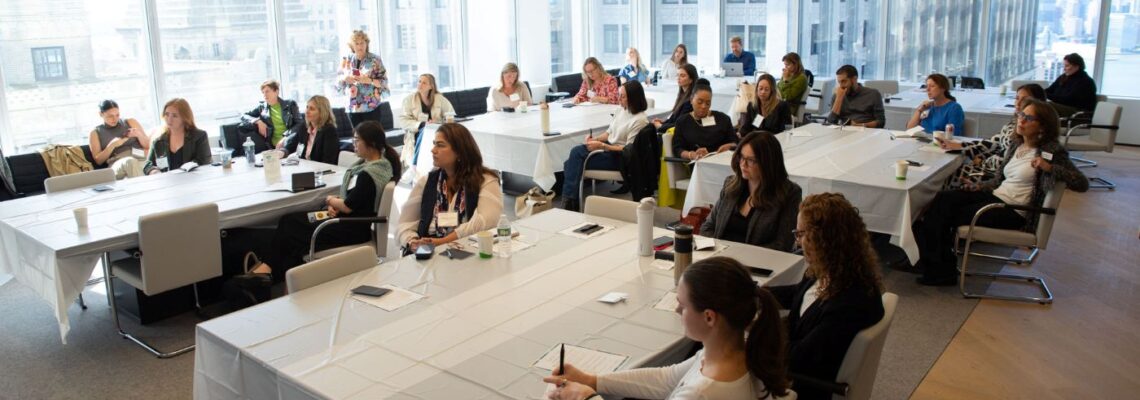
WMP’s first in-person event landed on March 11, 2025, just after International Women’s Day. “We didn’t want another panel about ‘women in leadership,” Balian intersects. “We wanted a room of people who actually run budgets.”
The full-day session gathered 30 senior marketers, procurement leads, and agency founders to tackle three realities reshaping the industry:
The tone was candid. “If procurement doesn’t claim the strategic ground, someone else will — and they’ll charge you for it,” Moore told the room.
Those conversations produced a set of pragmatic take-aways: run frequent contract audits to uncover hidden inefficiencies, update agency MSAs with AI clauses and ownership safeguards, and keep retail media budgets tied to ROI rather than publisher quotas.
Building topics by staying close to the market
Moore and Balian don’t crowdsource agendas months ahead. “We keep our hands on the pulse every day — client calls, deal reviews, LinkedIn debates — then we shape sessions around what’s actually happening,” Moore says. From there, they curate experts who live the issue: legal leads dissecting AI clauses, indie founders discussing flexible staffing models, procurement heads benchmarking new contract models. “If you’re invited,” Balian says, “it’s because you bring proof, not theory.”
October 8, 2025: Advertising Week and a Packed Room
By October, WMP’s reputation had spread. The October Roundtable, held on Wall Street in partnership with Frankfurt Kurnitz during Advertising Week New York, drew a sold-out crowd — and, for the first time, Ad Age took notice.
“Most of the content at Advertising Week New York is very relevant for procurement,” Moore told Ad Age. “We’re recommending that executives attend marketing events — not just procurement-led conferences — to stay ahead of the real conversations.”
According to the Ad Age, the WMP event brought together procurement executives from top brands in luxury, retail, liquor, FMCG, alongside agencies such as Known, Murder Hornet, and Good-Loop, MBooth, Taylor and Frankfurt Kurnitz.
Shalene Monahan from USPS summed it up in the article:
“With Advertising Week happening just across town (New York), it’s clear we’re all asking the same questions — how to work smarter, collaborate better, and future-proof creativity.”
A Rare Spotlight
That Ad Age coverage mattered. The magazine rarely writes about procurement unless there’s a controversy. This time it was about progress — how procurement is showing up as a driver of marketing intelligence. “Ad Age validating the work signals that accountability and creativity aren’t at odds,” Moore says. “They’re finally in the same sentence.”
Inside the October Roundtable
The October agenda extended WMP’s earlier themes — but with sharper edges. Sessions explored scaling when working with independents, contracts in the age of AI, PR as a strategic growth driver considering GEO, and purpose-led performance.
Attendee feedback captured the tone:
“Exciting topics — even ahead of schedule compared to most companies.” “Panelists were wisely selected, interesting, and diverse … each topic felt real and applicable.” “Loved the Contracts in the Age of AI discussion — relevant and spot on.” “PR in the Age of AI changed how I think about our marketing spend.”
Another summed it up:
“An incredible and thoughtful event for the marketing industry’s often unsung heroes — procurement professionals.”
Key take-aways mirrored that energy:
Procurement Without the Apology
What makes WMP different is the absence of spin. Moore is direct about procurement’s historic baggage. “For years, marketing heard the word ‘procurement’ and braced for cuts,” she says. “We’re proving that discipline and creativity can build together if you understand both sides of the deal.”
That authenticity is why agencies attend. At WMP, they’re not being judged on cost tables but invited to explain how they price talent, use AI, or build hybrid models. “We’re not doing beauty parades,” Balain says. “We’re building a shared vocabulary.”
Moore’s Path: Seeing the Whole Picture
Part of what gives WMP its credibility is the breadth of Moore’s own experience. She’s spent more than 20 years navigating every side of the marketing economy — client, agency, and auditing.
She began on the client side at PepsiCo, managing an international marketing budget of nearly half a billion dollars. “I was (somewhat) young and endlessly curious,” she says. “I kept asking why things were done a certain way — why agencies worked the way they did, how we could collaborate better.”
That curiosity led her to be headhunted into the agency world, where she spent years in client finance and CFO roles across four of the top holding companies. “Seeing it from the inside gave me a whole new view of how money, creativity, and politics mix,” she says.
From there, she joined the largest marketing audit firm at the time, leading its North American division. That’s where the light bulb went off.
“When I worked within audits, I realized there was huge demand for support for marketing procurement,” Moore explains. “But no one was selling a coherent approach. Every vendor had their own tool or benchmark, and procurement teams were left stitching together reports to make strategic decisions. That’s where RAUS comes in — to make marketing procurement make sense.”
Her firm, RAUS Global, now works with brands worldwide to help solve strategic and tactical projects, alongside procurement, bringing commercial logic to complex marketing ecosystems.
Balain’s Lens
Balain brings the creative pragmatism that keeps WMP balanced. As a partner at AlixPartners with deep roots in luxury marketing, she’s now focused on generative AI in content production — finding ways to deliver high-end creative faster and smarter. “I’m not trying to replace artists,” she says. “I’m making sure brands spend wisely and still look incredible. That’s what smart procurement enables — quality without waste.”
Moore nods to that as WMP’s core principle: commercial fluency and creative empathy aren’t opposites. “Balain proves it every day.”
Curated, Not Crowded
WMP isn’t an events business; it’s a curated exchange. There are no sponsorship booths or generic panels — just real contributors hand-picked for relevance. “If you’re in the room, you’re part of the solution,” Moore says.
Slides and quotes from both 2025 sessions have since circulated through client decks and internal trainings. Moore doesn’t mind. “If our ideas spread, good. The whole point is to make procurement smarter across the board.”
Why It Works
Part of WMP’s success is timing: marketing procurement is in flux. AI is reshaping how agencies bill, data privacy is redrawing value chains, and sustainability metrics are creeping into contracts. The other part is tone. WMP’s rooms feel safe — not politically correct, but commercially honest. “We speak the same language,” one attendee wrote afterward. “Every session was tailored to the real challenges we face.”
Looking Ahead
Moore and Balain plan two sessions in 2026 — one in Europe, one on the US west coast— but both are cautious about scale. “We’d rather stay boutique and meaningful than become another event logo farm,” Balain says.
They also want to deepen capability-building: webinars to build new capabilities, contract-writing workshops, and agency-evaluation labs. “It’s about transferring capability, not preaching it,” Moore adds.
A quiet shift with big implications
At its core, WMP is changing the narrative of what leadership looks like in marketing procurement. It’s not about who shouts loudest, but who knows how to connect the creative and commercial dots.
As Moore puts it:
“Procurement isn’t the department of “no” It’s the department of “know” Once we prove that, women in this space aren’t just invited to the meeting — they’re running it.”